When I first came to Child and Adolescent Behavioral Health (C&A), I was unsure what to expect regarding race and diversity at both the organization and in Ohio. Having grown up in Harlem in New York City and attended graduate school in San Diego, CA, I had heard stereotypes about Ohio, specifically that Ohio was a very white state. At C&A during orientation, we discussed the role of first impressions for clients and discussed how the front desk staff are considered, “the directors of first impressions.” I loved this term. After orientation, I wondered, why we didn’t discuss demographic factors such as race and gender? We generally pick those up upon first impressions and have implicit biases and judgements in those first impressions. It was odd to me that we did not discuss these demographic factors.
As the summer and fall progressed, I noticed that there were few discussions about race as it impacts C&A and the kids and families we serve. I noticed the number of white staff at C&A and reflected on my own privilege as a white man who can easily avoid the discussion of race because I do not suffer discrimination on an individual or systemic level. I reflected on my first experiences discussing race in high school.
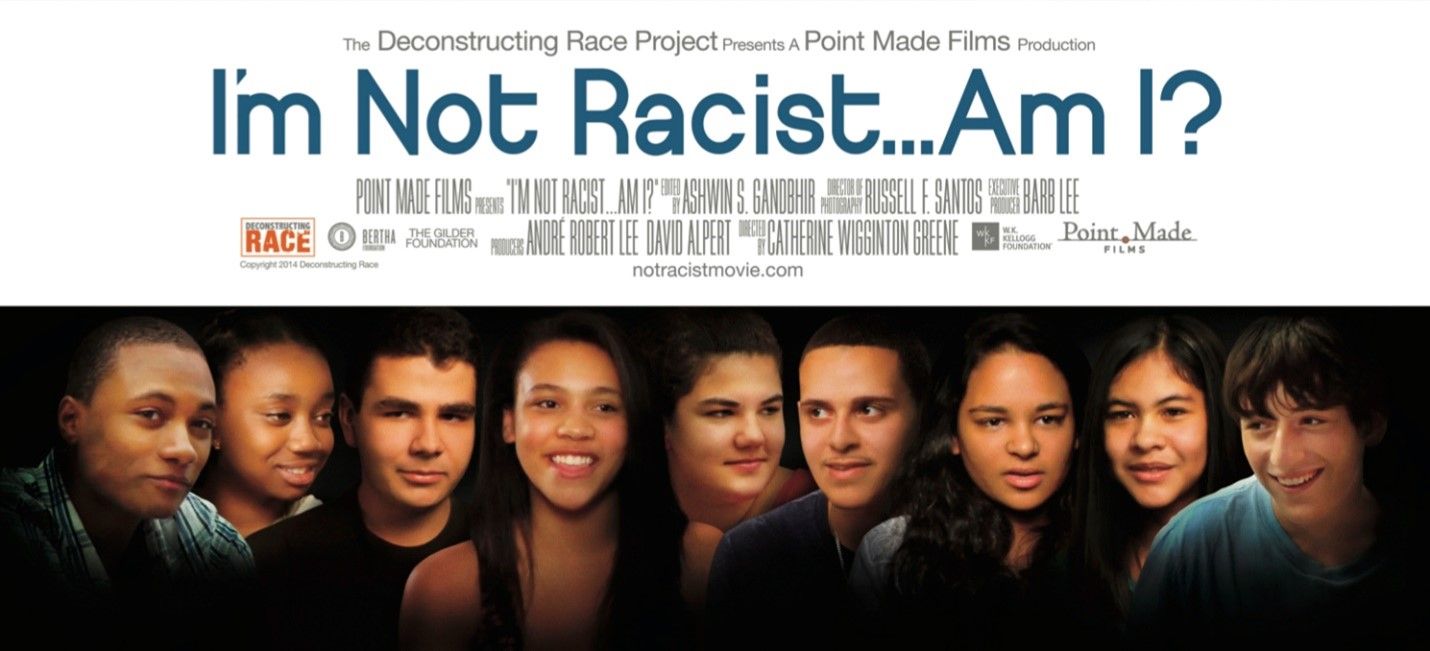
When I was in high school at the Calhoun School, my father received a grant to create a film and workshops that addressed race and racism seen through the eyes of high schoolers in New York City. My dad had completed a training hosted by the People’s Institute for Survival and Beyond. This training opened my father’s eyes to his own white privilege and motivated him to teach kids, specifically white kids, about their privilege earlier in life. I first saw the film, I’m Not Racist… Am I? (see more
here), toward the end of high school after it had come out in 2014.
I’m Not Racist… Am I? follows a group of 12 high school teens through a series of workshops that focus on understanding race and racism from both an individual and systemic level. You can learn more about the teens themselves
here. The teens came from different boroughs in New York City, were all of differing socio-economic status, and differed in race and gender. I introduced and screened this film at C&Aon Oct.16 and then Catherine Wigginton Greene, the director, facilitated a discussion for those in attendance.


The teens in the film experienced various workshops focused on undoing racism from a systemic perspective, understanding stereotypes that affect individuals of different racial backgrounds both individually and systemically, exploring the meaning and contexts of the N word, and other discussions evaluating the teens’ personal experiences of race, racism and white privilege. Following the screening of the film, I continued to reflect on how my own personal privileges play a role systemically, interpersonally and within the therapeutic context.
In 2017, the American Psychological Association (APA) published multicultural guidelines for therapy entitled Multicultural Guidelines: An Ecological Approach to Context, Identity and Intersectionality, 2017. In their second guideline, the APA states: “Psychologists aspire to recognize and understand that as cultural beings, they hold attitudes and beliefs that can influence their perceptions of and interactions with others as well as their clinical and empirical conceptualizations. As such, psychologists strive to move beyond conceptualizations rooted in categorical assumptions, biases and/or formulations based on limited knowledge about individuals and communities.” (p. 4).
The APA expands upon this guideline more specifically as it relates to privileged demographic factors and the traditional avoidance of discussions of power:

It is important that researchers, clinicians, educators and consultants consider the effects of privilege on their interactions with participants, clients, students and consultees, and that privileged identities (e.g., White/White American, male, heterosexual, middle class, cisgender and able-bodied) often remain invisible to others and to themselves and are therefore assumed to be normative (McIntosh, 2015). The issue of privilege is connected with systemic issues in training that contribute to challenges associated with engaging in a dialogue concerning multicultural issues.” (p. 33).
Furthermore, in an article on Psychotherapy.Net, Dr. Margaret Clausen identifies the difficulties white clinicians face when encountering racism content in psychotherapy. Dr. Clausen states, “As a white person, accounting for one’s own racial identity and racism, talking about the larger system of racism bestowing power and privilege, is typically a conversation stopper among white people.” She goes on to discuss race as it impacts white clinicians conducting psychotherapy: “The obstacles to creating open dialogue seem to be about several factors, among them: white guilt; protecting privilege; the nature of trauma (racism and acts related to it) evoking blaming and shaming; the lack of practice white people have in talking productively to one another about racism; desires to maintain an all-good self; the lack of white racial identity development and awareness; and the significant discomfort of sitting with the realities of and felt gratitude for the enormous privilege and protection light skin brings in our daily lives.”
Furthermore, in his book, Drug Use for Grownups, Dr. Carl Hart expands upon the difficulties of seeking therapy himself when his son is faced with racism at school. Hart states: “This work is beyond the expertise of typical U.S. therapists, who are rarely trained in matters of race, especially as it relates to the impact of racism on mental health functioning and on parenting.” (p. 154). These experiences may hinder individuals’ interest in seeking mental health services, especially since most therapists and psychologists are white and the mental health concerns of people of color are growing or becoming more apparent than they were in the past (Kim, 2022).
As clinicians, and as a white clinician, it is my duty to be aware of biases and privileges as they impact my ability to provide clinical care, and my role in perpetuating stereotypes and discrimination interpersonally among staff and patients. The APA expands upon this need for privileged individuals to do their own work rather than to lay the burden on people of color and marginalized communities: “…multicultural education is not intended to be provided solely by faculty who identify as minorities (e.g., racial, gender, or sexual), as this contributes to the problem of categorization and marginalization within psychology, and it dismisses the importance of faculty from all sociocultural backgrounds investing their time and resources to examining and addressing the influence of their beliefs, attitudes, and assumptions on education and training.” (p. 33).
As a clinician providing meaningful psychotherapy, I challenge my patients to confront hard conversations, be open-minded, and not fall into avoidance out of guilt, shame and fear. I must practice what I preach. Just as I encourage the self-care of my clients, I must prioritize it myself. If I expect my patients to confront difficulties, I must confront difficult topics that I may otherwise avoid as a result of my privilege. Although I may not be able to choose how I look or how others perceive me, I have the power to react to those perceptions and decide how I want to behave and make an impact on myself and others. I do not consider myself an expert, but I am invested in growing my psychotherapy skills and general awareness as they relate to issues of race and discrimination.
References:
American Psychological Association. 2017. Multicultural Guidelines: An Ecological Approach to Context, Identity, and Intersectionality. Retrieved from: http://www.apa.org/about/policy/multicultural-guidelines.pdf
Clausen, M. (2015) Whiteness Matters: Exploring White Privilege, Color Blindness and Racism in Psychotherapy. Psychotherapy.net. https://www.psychotherapy.net/article/racism-white-privilege-psychotherapy#section-white-therapist-as-racial-subject
Hart, C. L. (2021). Drug Use for Grownups: Chasing Liberty in the Land of Fear. Penguin Books.
Kim, R. (2022, March 7). Addressing the Lack of Diversity in the Mental Health Field. NAMI. https://www.nami.org/Blogs/NAMI-Blog/March-2022/Addressing-the-Lack-of-Diversity-in-the-Mental-Health-Field#:~:text=According%20to%20a%20report%20from,mental%20health%20counselors%20were%20white
McIntosh, P. (2015). Extending the knapsack: Using the White privilege analysis to examine conferred advantage and disadvantage. Women & Therapy, 38(3–4), 232–245.
C&A’s Doctoral Intern Chris Alpert presented the information for this blog post at an agency training. This is part 1 of a three-part series. In the second post, Alpert will discuss what the student’s learned about themselves participating in the project. Alpert’s doctoral internship with C&A will end on June 30, 2024. For more information regarding this topic, please reach out to C&A at 330.433.6075.
RECENT POSTS